
ExamCure Team
Jul 24

DOH GP Pearson VUE Exam 2026: Complete Guide for General Practitioners in Abu Dhabi

Key Takeaways

If you want to start GP work in Abu Dhabi on time, treat the DOH GP Pearson VUE Exam as a fixed milestone in your licensing timeline, not an afterthought. It is a required step in the DOH General Practitioner pathway and focuses on clinical decision-making in primary care style cases you would see in day-to-day practice.

Also, most avoidable delays come from admin steps, not studying. You can often move faster by preparing documents early, completing credential verification carefully the first time, and booking your Pearson VUE slot as soon as you become eligible.

Next, aim for a plan that makes your performance predictable, not hopeful. A pass-ready approach combines the official blueprint topics with timed question practice, tracking weak areas weekly, and doing full-length mocks to check stamina and pacing.

Quick checklist

  • Confirm the exam is required for your DOH GP licensing route

  • Gather documents early and verify details match across records

  • Complete credential verification carefully to avoid rework

  • Book Pearson VUE as soon as eligibility opens

  • Study from the blueprint first, then add timed questions

  • Track weak areas (for example, 2 to 3 topics per week)

  • Schedule at least 1 full-length mock before your exam date

Trying to start GP work in Abu Dhabi without getting stuck in licensing delays

You have an offer in principle, but the start date keeps moving because three items are tied together: eligibility, Primary Source Verification (PSV), and an available exam slot. If any one of those slips, onboarding slips too, even when the employer is ready to proceed.

Most candidates need about 6–12 weeks to prepare for the DOH GP Pearson VUE exam, and that is before you add the extra time for verification and scheduling. The practical move is to plan your licensing steps as a timeline with dependencies, not as a checklist you start “later.”

Next, map your route from today to a final DOH license with clear milestones you can track week by week:

  • Eligibility check: confirm you meet the DOH requirements before you spend time and money on the wrong route

  • Document readiness: gather core documents early (passport, degree, registration, certificates, work history, good standing) so PSV does not stall on missing or mismatched details

  • PSV submission and follow-ups: treat PSV as a project with weekly follow-ups, not a one-time upload

  • Exam preparation window: block a realistic study period (often 6–12 weeks) and choose a test date that matches your readiness, not your anxiety

  • Exam scheduling: book as soon as you can once eligible, because waiting for the “perfect” date can force a later slot

  • Post-exam steps to licensing: plan time for result processing and any remaining DOH application steps before you promise a start date

But timing choices come with tradeoffs. Booking an exam slot early works best when you can commit to a consistent study plan (for example, 60–90 minutes on weekdays plus a longer block on weekends); it fails when your documents are still incomplete and eligibility is uncertain, because you risk rescheduling pressure while PSV is still pending.

If you do one thing, do this: start PSV and exam prep in parallel once you are confident you are on the correct eligibility pathway. A common mistake is waiting for PSV to fully finish before starting prep, then scrambling for an exam slot and losing another month.

Confirm you’re eligible and ready for credential verification

Next, confirm you actually need the DOH GP exam for the role you want, because the fastest way to lose weeks is to register for the wrong pathway. In practice, the exam is typically relevant when you are applying to work as a General Practitioner and DOH needs to validate your training and recent practice to match that scope.

Here’s why: eligibility is not just about having an MBBS or equivalent, it is about whether your profile matches the GP pathway DOH will verify. GP applicants who commonly fit this route include clinicians who completed a recognized medical degree, finished an internship, and have recent, documentable clinical practice, even if they are not applying as a specialist.

That said, treat credential verification as a documentation project with strict consistency rules. If you do one thing, make your documents match each other on names, dates, and identifiers before you upload anything.

Use this checklist to spot gaps early:

  • Medical degree certificate and, if available, transcript

  • Internship completion certificate with start and end dates

  • Experience letters stating role, department, hours or full-time status, and exact employment dates

  • Current or most recent professional license or registration

  • Good standing certificate from the relevant authority (if required for your profile)

  • Government-issued photo ID (passport is commonly used)

  • Name-match proof if your name varies across documents (for example, marriage certificate or affidavit), plus a clear pattern for how you will write your name everywhere

Here’s the catch: credential verification often fails on small inconsistencies rather than missing major documents. Common mistakes include swapped day and month in dates, different spellings of a family name, or experience letters that do not clearly state your clinical title and dates.

If you’re short on time, prioritize these first because they block most reviews: your degree, internship proof, license, and one strong experience letter that clearly covers the most recent 6 to 12 months. Then fill in the rest to reduce back-and-forth and keep your exam and licensing timeline predictable.

Register the right way and understand the full DOH licensing pathway
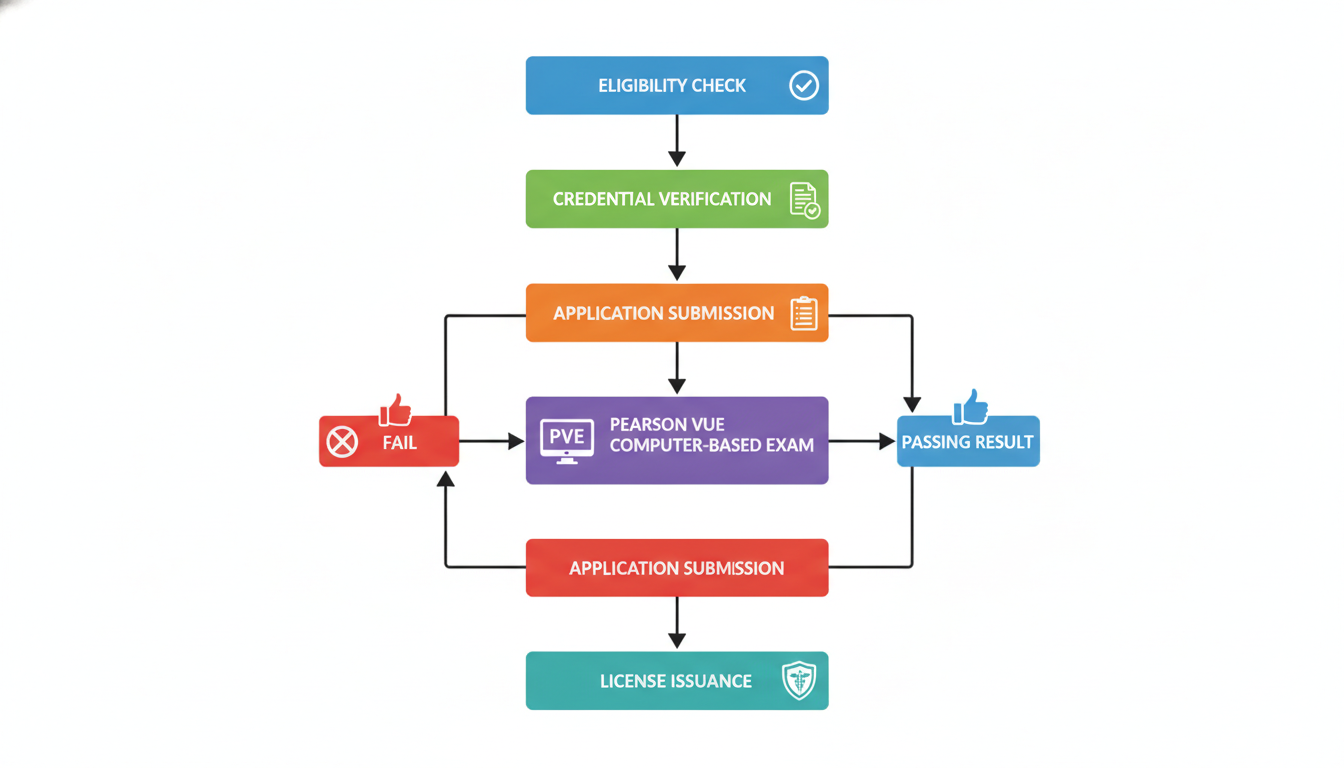
Next, treat registration like a checklist, not a form you rush through on a busy shift. Most preventable delays happen after you hit submit, when a small mismatch forces rework and your timeline slips by days or weeks.

A practical way to think about the pathway is five milestones that must happen in order. If you can name where you are in the chain, you can also predict what documents, emails, and deadlines are coming next.

Milestone 1: DOH account and application setup

Start with your DOH account and the initial application details (role, specialty, identifiers, contact email). If you do one thing here, make your name spelling and date of birth match your passport and your core credentials, character for character.

Common mistake and fix:

  • Mistake: Using a different email than the one you check daily

  • Fix: Use one inbox and add calendar reminders to check it at least once every 24 hours

Milestone 2: Primary Source Verification (dataflow-style PSV)

This is the step where your degree, license, and experience are verified at the source (for example, your university or licensing body). It works best when your documents are clear, complete, and consistent; it tends to fail when uploads are blurry, cropped, or don’t match the details the verifier expects.

Failure points to avoid:

  • Incomplete uploads (missing stamp, back page, or translation where required)

  • Credential mismatches (different names across documents, inconsistent license numbers)

  • Uploading the wrong document type (for example, an employment letter when a license certificate is requested)

Milestone 3: Eligibility outcome

So, once PSV is complete, you receive an eligibility outcome and next-step instructions. Here’s the catch: missed emails are a major cause of stalled applications, especially when requests for clarification have short response windows.

If you’re short on time, skip repeatedly refreshing the portal and do this instead:

  • Check your inbox and spam folders at a set time daily

  • Save DOH and verification sender domains to your contacts

  • Reply to any clarification request the same day with a single, well labeled set of files

Milestone 4: Pearson VUE scheduling

That said, eligibility is not the finish line, it is what lets you schedule with Pearson VUE. Choose a test date that gives you a realistic buffer for work and family obligations. A common planning trap is booking “the first available slot” and then paying rescheduling fees or losing momentum when you need to move it late.

A simple buffer rule many clinicians use in practice:

  • Book 2 to 4 weeks ahead if you are already doing timed question blocks 4 to 5 days per week

  • Book 6 to 10 weeks ahead if you are still building baseline content review

Milestone 5: License issuance

In practice, once you pass and your file is complete, you move to license issuance steps inside the DOH process. This stage is usually straightforward, but it can still slow down if your uploads are incomplete or if your contact details were entered incorrectly earlier.

Quick self-check before you expect final processing:

  • All required uploads are present and readable

  • Names, dates, and credential numbers match across documents

  • You have not missed any portal messages or email requests

  • Your planned exam date leaves room for changes without last-minute rescheduling

support@examcure.com

Master the exam blueprint, format, scoring, and high-yield syllabus areas

Next, treat the exam blueprint like your study schedule. If you know the timing, question style, and what gets scored, you can stop over-studying low-yield details and start practicing the clinical decisions the exam is actually testing.

In a Pearson VUE computer-based setting, expect a quiet, proctored room, on-screen navigation, and a steady pace requirement. A practical benchmark is that you should be comfortable making a defensible choice in about 60 to 90 seconds per question, because long deliberation on early items often causes time pressure later.

But the bigger challenge is question style, not the chair and the screen. Many items are built around short clinical vignettes where you must pick the next step, best test, safest medication, or immediate management, often with distractors that are "almost right".

Common mistake: focusing on memorizing rare diseases instead of common presentations. Fix: for each topic you review, write one mini algorithm in plain words (for example, chest pain triage, asthma step therapy, antenatal bleeding) and then practice questions until you can apply it under time pressure.

What to expect at Pearson VUE and how to prepare for it

So prepare for the computer-based format the same way you prepare for clinical work: fast pattern recognition plus safety checks. A useful routine for every vignette is:

  • Identify the life threat first (airway, breathing, circulation, sepsis, ectopic pregnancy)

  • Decide if this is outpatient vs ED now

  • Choose the single best next step, not everything that could be done

  • Re-check contraindications (pregnancy, renal failure, anticoagulants, allergies)

Tradeoff: doing long reading sessions works best when you are building baseline knowledge early. It fails when you are within the last 2 to 3 weeks, where timed question sets and review of wrong answers usually gives better score movement.

High-yield topic map for GP scope

That said, high-yield does not mean narrow, it means common, risky, and guideline-driven. Use this GP topic map to plan your weeks and to spot gaps quickly:

  • Internal medicine: diabetes, hypertension, dyslipidemia, thyroid disease, COPD/asthma, heart failure, ischemic heart disease, CKD basics, anemia patterns, common infections

  • Family medicine: chronic disease follow-up plans, medication reconciliation, risk counseling, red-flag symptoms, referrals

  • Pediatrics: fever approach, dehydration, asthma/wheeze, otitis media, growth and development flags, vaccination schedules concepts

  • OBGYN: antenatal care basics, hypertensive disorders, gestational diabetes screening concepts, postpartum hemorrhage initial steps, contraception counseling

  • Surgery: acute abdomen approach, appendicitis vs biliary colic, wound care, perioperative risk basics, DVT prophylaxis concepts

  • Emergency: chest pain, stroke recognition, anaphylaxis, sepsis early management, trauma basics, status asthmaticus, diabetic emergencies

  • Prevention: screening principles by age and risk, immunization principles, smoking cessation, obesity counseling, occupational health basics

  • Ethics and professional practice: consent, confidentiality, capacity, documentation, fitness to work, safe prescribing

If you do one thing, do this: build a weekly split that mirrors your likely patient mix (for example, 40% internal medicine, 20% emergency, 15% pediatrics, 15% OBGYN, 10% prevention and ethics), then adjust based on your question-bank performance.

Who needs this exam

";
You should take the DOH GP Pearson VUE Exam if you want a General Practitioner license from the Department of Health, Abu Dhabi. It applies to experienced physicians and eligible recent graduates.
;

International Medical Graduates

";
Many candidates are IMGs with primary medical qualifications outside the UAE. Your education and experience must meet current DOH licensing requirements, regardless of where you studied.
;

Work options and readiness

";
DOH-licensed GPs can work in primary care, family medicine clinics, private and government hospitals, occupational health, and telemedicine. Expect clinical reasoning questions. Typical prep takes 4, 8, or 12 weeks.
;

DOH GP eligibility requirements

";
Before you book the DOH GP Pearson VUE Exam, you must meet Department of Health Abu Dhabi eligibility rules. These confirm your qualifications, clinical experience, and professional standing for safe patient care.
;

Core criteria for most GPs

";
  • Recognized medical degree (MBBS or equivalent) from an accredited school accepted under DOH Professional Qualification Requirements

  • Completed one-year rotating internship with valid certificate

  • Post-internship clinical experience in general practice or primary care, documented by employer certificates and consistent registration history

  • Current or previous professional registration or license in your practice country, with no restrictions

  • Certificate of Good Standing confirming valid status and no disciplinary actions

  • Continuous recent practice, with gaps explained by supporting documents

;

What eligibility allows you to do

";
Meeting eligibility does not grant a license. It lets you proceed to DataFlow primary source verification, application review, the exam when required, and the remaining DOH licensing steps.
;

Required documents and PSV

";
After eligibility, prepare your licensing file and complete DataFlow Primary Source Verification. DOH uses PSV to confirm your qualifications, registration, and experience before exam approval and to reduce avoidable delays.
;

Documents commonly required

";
  • Valid passport

  • Recent passport-sized photo

  • Primary medical degree (MBBS or equivalent)

  • Internship completion certificate

  • Postgraduate qualifications (if applicable)

  • Medical license or registration certificates

  • Certificate of Good Standing

  • Experience certificates

  • Updated CV

  • Any additional documents requested by DOH

;

DataFlow PSV and tips

";
DataFlow verifies credentials with the issuing source, including degree, internship, license, employment, and postgraduate awards. Use matching names and dates, upload clear scans, reply fast to requests, and start early.
;

DOH GP Pearson VUE Exam 2026: Complete Guide for General Practitioners in Abu Dhabi (Part 5) How to Register for the DOH GP Pearson VUE Exam

After meeting the eligibility requirements and completing the required credential verification, the next step is to register for the DOH GP Pearson VUE Exam. The registration process involves the Department of Health (DOH), the TAMM platform, and Pearson VUE, which delivers the computer-based examination. Although the process may appear complicated at first, following each step carefully will help ensure a smooth application.

Step 1: Create Your DOH Application

Begin by creating your healthcare professional application through the official TAMM platform, which provides access to DOH licensing services. During this stage, you will:

  • Create your applicant profile.

  • Select the appropriate professional category (General Practitioner).

  • Upload the required documents.

  • Submit your application for review.

Your information should exactly match your passport and professional documents to avoid delays during verification.

Step 2: Complete DataFlow Verification

Before you can proceed to the examination, your educational qualifications, professional registration, internship, and employment history are verified through DataFlow Primary Source Verification (PSV). The verification process may take several weeks depending on:

  • The number of documents submitted.

  • The responsiveness of universities and employers.

  • Whether additional information is requested.

Starting this process early can significantly shorten your overall licensing timeline.

Step 3: Receive Eligibility Approval

Once your application has been reviewed and you meet the applicable requirements, the Department of Health approves you to enter the examination phase. Only after this approval can you proceed with payment and exam booking through Pearson VUE.

Step 4: Pay the Examination Fees

After eligibility approval, complete the required examination payment through your DOH application in TAMM. Once payment is confirmed, your account provides access to Pearson VUE for scheduling your examination.

Step 5: Book Your Pearson VUE Exam

Using the Pearson VUE link provided in your DOH account, you can:

  • Select your preferred testing country.

  • Choose a convenient Pearson VUE test center.

  • View available examination dates.

  • Select your preferred appointment time.

  • Confirm your booking.

After completing your reservation, download and keep your booking confirmation for exam day.

Can You Take the Exam Outside the UAE?

Yes. One advantage of the Pearson VUE system is that eligible candidates can often take the DOH licensing examination at authorized Pearson VUE test centers in many countries around the world, subject to availability. This allows many international applicants to complete the examination before relocating to the UAE.

Tips for a Successful Registration

To avoid unnecessary delays:

  • Apply well in advance of your intended employment date.

  • Double-check all uploaded documents before submission.

  • Monitor your TAMM account regularly for updates or requests.

  • Book your exam early, especially during periods of high demand.

  • Keep copies of your payment receipt and Pearson VUE booking confirmation.

Proper planning can make the registration process much smoother and help you focus on what matters most-preparing for the examination.

In the next section, we will explore the DOH GP Pearson VUE exam format, including the question style, exam duration, scoring approach, and what you can expect on test day.

DOH GP Pearson VUE exam format

";
Knowing the format helps you plan timing, practice effectively, and reduce surprises on test day. The DOH GP exam focuses on safe primary care decision-making in common clinical scenarios.
;

CBT, questions, and timing

";
You sit a Pearson VUE computer-based test at an authorized test center after a short interface tutorial. Expect 120 single-best-answer MCQs in 2.5 hours (150 minutes), about 75 seconds per question.
;

Question style and scoring

";
Most items are clinical vignettes testing diagnosis, investigations, management, emergencies, prevention, ethics, and patient safety. Negative marking is not published. Results are Pass or Fail and support licensing, not grant it alone.
;

DOH GP Pearson VUE Exam 2026: Complete Guide for General Practitioners in Abu Dhabi (Part 7)

";
DOH GP Syllabus 2026 Success in the DOH GP Pearson VUE Exam depends on more than simply memorizing medical facts. The examination evaluates your ability to apply evidence-based clinical knowledge to diagnose, investigate, manage, and counsel patients in a primary care setting. While the Department of Health does not publish a detailed percentage breakdown for every specialty, candidates should prepare comprehensively across the core disciplines expected of a competent General Practitioner. The following subjects form the foundation of most successful study plans.
;

Internal Medicine

";
Internal Medicine is generally regarded as the most important subject for GP candidates because many primary care consultations involve adult medical conditions. Focus on high-yield topics such as: Hypertension Diabetes mellitus Dyslipidemia Ischemic heart disease Heart failure Cardiac arrhythmias Asthma Chronic obstructive pulmonary disease (COPD) Pneumonia Tuberculosis Chronic kidney disease Acute kidney injury Thyroid disorders Anemia Liver diseases Gastrointestinal bleeding Peptic ulcer disease Viral hepatitis Rheumatologic disorders Infectious diseases commonly encountered in primary care Pay particular attention to current clinical guidelines, appropriate investigations, long-term disease management, and indications for referral.
;

General Surgery

";
General Practitioners are expected to recognize common surgical conditions, initiate appropriate management, and identify patients requiring urgent referral. High-yield surgical topics include: Acute abdomen Appendicitis Gallstone disease Intestinal obstruction Hernias Breast lumps Thyroid disorders Hemorrhoids Trauma assessment Burns Wound management Surgical infections Perioperative assessment Basic orthopedic emergencies The examination emphasizes recognizing emergencies rather than performing specialist surgical procedures.
;

Pediatrics

";
Pediatrics represents a significant component of everyday general practice. Important areas include: Growth and developmental milestones Childhood immunization schedules Neonatal jaundice Neonatal emergencies Fever in children Respiratory infections Gastroenteritis Dehydration Asthma in children Seizures Common skin disorders Nutritional deficiencies Childhood anemia Developmental disorders Pediatric emergency management Candidates should be comfortable with age-specific diagnosis, treatment, and referral decisions.
;

Obstetrics and Gynecology

";
General Practitioners frequently provide women's health services and antenatal care, making Obstetrics and Gynecology another major area of the examination. High-yield topics include: Antenatal care Normal pregnancy High-risk pregnancy Gestational diabetes Hypertensive disorders of pregnancy Antepartum hemorrhage Postpartum hemorrhage Normal labor Obstetric emergencies Contraception Infertility Menstrual disorders Menopause Cervical cancer screening Common gynecological infections Candidates should understand when primary care management is appropriate and when urgent specialist referral is required. In the next section, we will cover the remaining high-yield disciplines, including Family Medicine, Emergency Medicine, Preventive Medicine, Medical Ethics, Professionalism, and the most frequently tested clinical topics for the DOH GP Pearson VUE Exam.
;

Key GP Domains

";
Beyond core specialties, the DOH GP Pearson VUE Exam 2026 tests your day-to-day primary care decision-making in Abu Dhabi across family practice, urgent presentations, prevention, and professional conduct.
;

Family Medicine focus

";
You are expected to manage common long-term conditions, provide continuity of care, and counsel patients using guideline-based primary care across all ages, with clear criteria for referral.
;

Emergency, prevention, ethics, and high-yield topics

";
Recognize and start initial management for emergencies, apply vaccination and screening guidance, and choose the most appropriate professional response in scenarios. High-yield conditions include HTN, diabetes, ACS, asthma/COPD, infections, CKD, and mental health.
;

How to Prepare for DOH GP Exam

";
The DOH GP Pearson VUE Exam rewards clinical reasoning and evidence-based decisions. A structured plan, guideline-based revision, and consistent MCQ and mock exam practice help you cover the syllabus and build confidence.
;

Start with the Exam Blueprint

";
Plan balanced coverage across Internal Medicine, Family Medicine, Pediatrics, Obstetrics and Gynecology, General Surgery, Emergency Medicine, Preventive Medicine, and Medical Ethics and Professionalism. Avoid revising only your strongest area.
;

Build your study around practice

";
Use current clinical guidelines, then reinforce learning with high-quality MCQs and timed full-length mocks. Track weak areas, review wrong options, and use spaced repetition with weekly specialty blocks and weekend cumulative revision.
;

Choose a plan that fits you

";
Your ideal DOH GP Pearson VUE Exam 2026 schedule depends on experience, weekly study time, and topic familiarity. Consistent 2 to 3 hours daily over weeks usually beats last-minute cramming.
;

Study plans: 4, 8, 12 weeks

";
4 weeks: revision for experienced GPs. Weeks 1 to 3 cover core specialties plus 150 to 200 MCQs and one mock. Week 4: weak areas, 2 to 3 mocks, pacing, no new material.
;

Avoid common mistakes

";
Top reasons candidates fail: memorizing without reasoning, too few MCQs, ignoring weak subjects, poor time management, outdated guidelines, skipping mocks, and studying without a structured plan. Final week: revise, timed mocks, rest, prepare documents, arrive early.
;

After you pass: common questions

Where can I see my DOH GP Pearson VUE exam result?

Your status appears in the Department of Health licensing system. Check it through your TAMM account inside your healthcare professional application, and save a copy for your records.

Does passing the exam mean I am licensed to work in Abu Dhabi?

No. Passing is only one requirement. You must also complete the remaining DOH licensing steps, such as eligibility approval, DataFlow Primary Source Verification, Certificate of Good Standing, document review, and fee payment.

When do I receive my DOH GP professional license?

Once all requirements are completed and your application is approved, DOH issues your General Practitioner license. This confirms your approved scope of practice under UAE healthcare regulations.

Can I apply for GP jobs before the license is issued?

You can start searching and interviewing, but many employers prefer candidates who have completed licensing because they can begin work sooner. Some roles may also require a sponsoring facility.

What should I do after licensing to maintain my career?

Plan ongoing CPD, keep up with evidence-based guidelines, and maintain professional standards. Many GPs also pursue further training in Family Medicine or other specialties to support long-term growth.

What to do after passing

";
Passing the DOH GP Pearson VUE Exam is a key milestone, but you still need to complete licensing steps before you can work as a General Practitioner in Abu Dhabi.
;

Check and save your result

";
Your outcome is processed in the DOH licensing system. Log in to your TAMM account, open your healthcare professional application, and keep a copy of the result for employers.
;

Finalize DOH licensing requirements

";

Before your license is issued, DOH reviews your full file, including:

  • Passed exam result

  • Approved eligibility

  • Completed DataFlow PSV

  • Valid Certificate of Good Standing

  • Required documents

  • Sponsorship or facility requirements when applicable

  • Licensing fees

;

Prepare with ExamCure DOH GP resources