
Emirates Medical Residency Entrance Exam Study Plan: 4-Week, 8-Week, and 12-Week Preparation Schedule

Jul 22 / ExamCure Team

Key Takeaways

  • Choose a 4, 8, or 12-week plan based on your baseline score, weekly hours, and deadline

    • If you have under 4 weeks, prioritize high-yield review and timed blocks

    • If you have 8 weeks, balance coverage with steady question volume

    • If you have 12 weeks, rebuild fundamentals first, then ramp up exam-style sets

  • Use weekly goals plus daily blocks to balance knowledge review, question practice, and exam-style timing

    • A typical weekday block can be 60 to 120 minutes

    • A weekend block can be 2 to 4 hours when you are off service

  • Track performance by topic and error type to adjust your plan every week

    • Common buckets: knowledge gap, misread stem, missed keyword, poor time split, second-guessing

    • If you only do one thing, do a weekly 15-minute review of missed questions and update the next week’s targets

You have the exam date, but your study time is uncertain

You know the exam date, but your calendar is a moving target. Maybe you can spare 1–3 hours on most weekdays, while weekends depend on call, family, and recovery, and you are not even sure whether you are starting from a solid baseline or relearning core topics.

Here’s the measurable part that makes planning easier: most candidates need 80–150 focused study hours, and by the final phase about 40–60% of your time should be question-based practice (timed questions, mixed sets, and targeted review). If you do one thing first, estimate your realistic weekly hours before you choose a 4-, 8-, or 12-week track.

A common mistake is building a schedule around a “perfect week” that happens once a month. The fix is to plan around your worst predictable weekdays (post-call, long clinic) and treat weekends as a bonus block you can scale up or down.

By the end of the next sections, you will pick the right timeline and follow a week-by-week schedule with a simple daily structure (what to read, what to practice, what to review) plus checkpoints so you can adjust without losing momentum.

Step 1: Pick the right timeline and define your weekly hours
Next, decide how many weeks you truly have, not how many weeks you wish you had. A practical benchmark is how many hours you can repeat every week for the next month or two (for many residents, that lands somewhere around 6 to 15 hours/week depending on rotations and call).

Use this self-triage to pick your timeline:

  • 4-week plan (last-minute): you have a near exam date, your baseline is decent, and you need fast, repeated question practice. Works best when you can do at least 10 hours/week. Fails when content gaps are wide and you keep switching topics

  • 8-week plan (balanced): you need both coverage and volume, and you can study most weeks without major drops. Works best when you can do 8 to 12 hours/week. Fails when your schedule swings hard week to week without a backup plan

  • 12-week plan (foundation-building): you are rebuilding basics, your confidence is low, or you have been away from exam-style questions. Works best when you can do 6 to 10 hours/week consistently. Fails when you try to cover everything equally and never increase question volume

If you do one thing, do this: write your weekly hours as a number you can protect, then build everything else around it. Set non-negotiables before you touch any schedule:

  • Weekly hours (example: 10 hours/week split across 5 days)

  • Protected days (example: 2 weekday evenings plus one longer weekend block)

  • Minimum question count target (example: 20 to 40 questions/day on study days, or 150 to 250 questions/week)

Common mistake: setting a plan based on a free week, then collapsing on a busy on-call week. Fix it by choosing a “worst-week” standard (for example, 6 hours/week minimum) and treating anything above that as bonus time for review blocks and extra questions

Step 2: Build your core weekly template that works on busy clinical days

Next, stop relying on motivation and build a repeatable week that still holds up after a long shift. Your goal is not a perfect plan, it is a plan you can run even on your worst weekday.

If you do one thing, keep the daily blocks the same and only change the time you spend in each block. This works best when you study in short, predictable sessions (30 to 90 minutes); it tends to fail when every session is a different task and you keep re-deciding what to do.

Daily blocks to run on autopilot

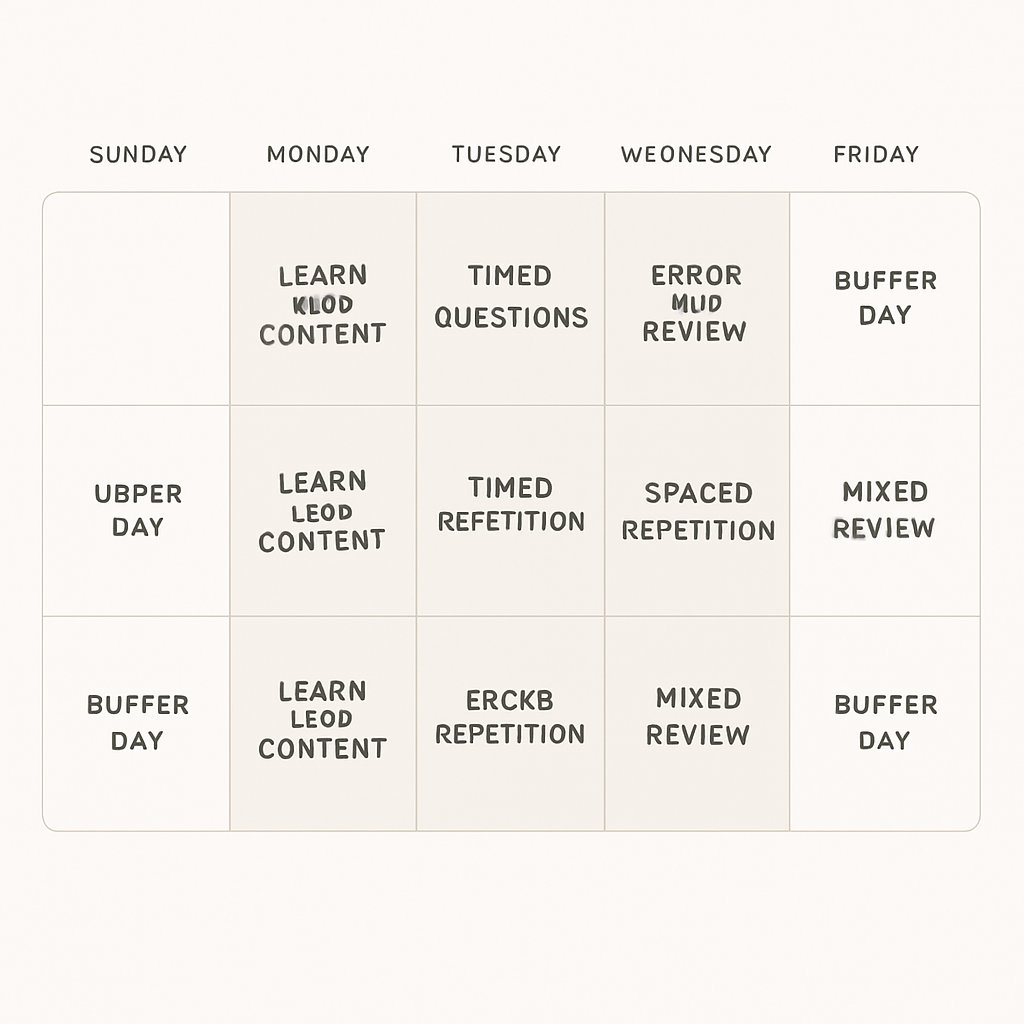
Also, use four blocks that match how most clinicians learn under time pressure: new content, timed questions, mistake review, and spaced repetition (re-seeing older material on a schedule). A common mistake is doing questions without tracking errors; fix it by keeping a small error log and reviewing it in short loops.

Use this as your default daily template:

  • Learn new content (20 to 40 minutes): one topic or one system, with a short set of notes

  • Timed questions (20 to 40 minutes): 10 to 25 questions to practice pacing

  • Review mistakes (15 to 25 minutes): re-read stems, identify why you missed it, write one-line fix in your error log

  • Spaced repetition (5 to 15 minutes): revisit 10 to 30 older flashcards or a quick “wrong answers” set

Weekly rhythm that survives real schedules

That said, your week needs slack built in, or it breaks the first time you get an extra call shift. A simple rhythm is 5 study days, 1 mixed review day, and 1 buffer day.

Try this weekly structure:

  • 5 study days: run the same four blocks and rotate topics (for example: cardio, resp, GI, neuro, mixed)

  • 1 mixed review day (60 to 120 minutes): redo missed-question sets, re-check your error log, and do one longer timed set to check pacing

  • 1 buffer day: no guilt day for shifts, family, or sleep debt; if you feel good, use it only for spaced repetition and light error-log review

Step 3: Follow the 4-week schedule for urgent, high-efficiency prep

Next, a 4-week plan works best when you already have a basic grasp of common systems but need to turn that knowledge into points quickly under time pressure. It tends to fail when you spend Week 1 re-reading everything, so your first goal is to expose gaps early and build an error log (a running list of missed questions, why you missed them, and what you will do differently).

If you do one thing, do this: start timed questions in Week 1, even if the score feels uncomfortable. That discomfort is data, and it tells you what to fix while you still have time.

Weeks 1–2: High-yield review plus rapid question exposure

Also, use the first 14 days to find weak systems fast (for example: cardio murmurs, antibiotic choices, OB triage, or pediatric rashes) rather than chasing perfect notes. A practical rhythm for a busy resident is 60–90 minutes of review followed by 30–60 minutes of questions on the same topic, 5–6 days per week.

Common mistake: doing large mixed question sets before you have any map of your weakest areas. Fix: keep questions semi-targeted in Weeks 1–2 and tag every miss in your error log with one of these labels:

  • Knowledge gap (you did not know the fact)

  • Misread stem (you missed a key word like “most likely”)

  • Process error (you knew it but chose too fast)

  • Time trap (you ran out of time and guessed)

Weeks 3–4: Mostly timed blocks, two full-length simulations, targeted remediation

That said, in Weeks 3–4 you shift from learning mode to performance mode. Aim for mostly timed blocks on exam-like pacing, then spend remediation time only on what your error log keeps repeating (for example, renal acid-base patterns, ECG localization, or pregnancy hypertension criteria).

A simple weekly structure for Weeks 3–4:

  • 3–5 timed blocks per week (pick a consistent time of day when possible)

  • 2 full-length simulations total (one at the start of Week 3, one about 5–7 days before your exam date)

  • 2–4 remediation sessions per week (45–75 minutes each) based on your highest-frequency errors

If you’re short on time, skip extra passive review and do one timed block plus a 30-minute error-log cleanup on the same day. For example, after a night shift, do a shorter timed set, then rewrite three misses into one-sentence rules you can recall on test day.

Step 4: Follow the 8-week schedule for balanced coverage and practice volume
Next, the 8-week plan works well when you can study most weeks but still have unpredictable clinical days.

A practical target is 10 to 14 hours per week (about 60 to 90 minutes on weekdays plus a 3 to 4 hour weekend block). If you do one thing, keep weekly practice consistent, because that is what makes your weak-area list accurate.

Weeks 1–4: systematic topic coverage + mini-mocks + cumulative review

  • Cover 2 to 3 topics per week (for example: cardiology + respiratory + a shorter topic like ethics)

  • Run one end-of-week mini-mock (25 to 50 timed questions) to test recall under time pressure

  • Schedule one cumulative review block each week (60 to 90 minutes) to revisit missed concepts from prior weeks

  • Keep an error log with 3 columns: topic, why you missed it (knowledge gap vs misread vs rushed), and the fix you will apply next time

Here’s the catch: early weeks can feel productive because you are “covering” lots of material, but coverage fails when you do not retest it.

Common mistake: doing review as rereading notes. Fix: pick 10 to 15 old missed questions and re-answer them cold before you look at explanations.

Weeks 5–8: more timed sets + 2 to 3 full-length simulations + aggressive weak-area targeting

  • Shift to 3 to 5 timed sets per week (for example: 20 to 30 questions per set, 40 to 60 minutes)

  • Complete 2 to 3 full-length simulations across the four weeks (for example: weekend mornings when you can protect time)

  • After each simulation, spend 2 to 3 hours reviewing only: missed questions, guessed questions, and any question that took too long

  • Use your weak-area list to drive the week: 60 to 70% of study time on weak topics, the rest on maintenance

If you’re short on time, skip extra reading and do this instead: one timed set + a focused review of mistakes on the same day.

Tradeoff to keep in mind: this 8-week plan works best when you can do at least two timed practice sessions per week; it fails when practice is pushed to the last two weeks, because you will not have enough data to target weaknesses reliably.

Step 5: Follow the 12-week schedule for rebuilding foundations and confidence

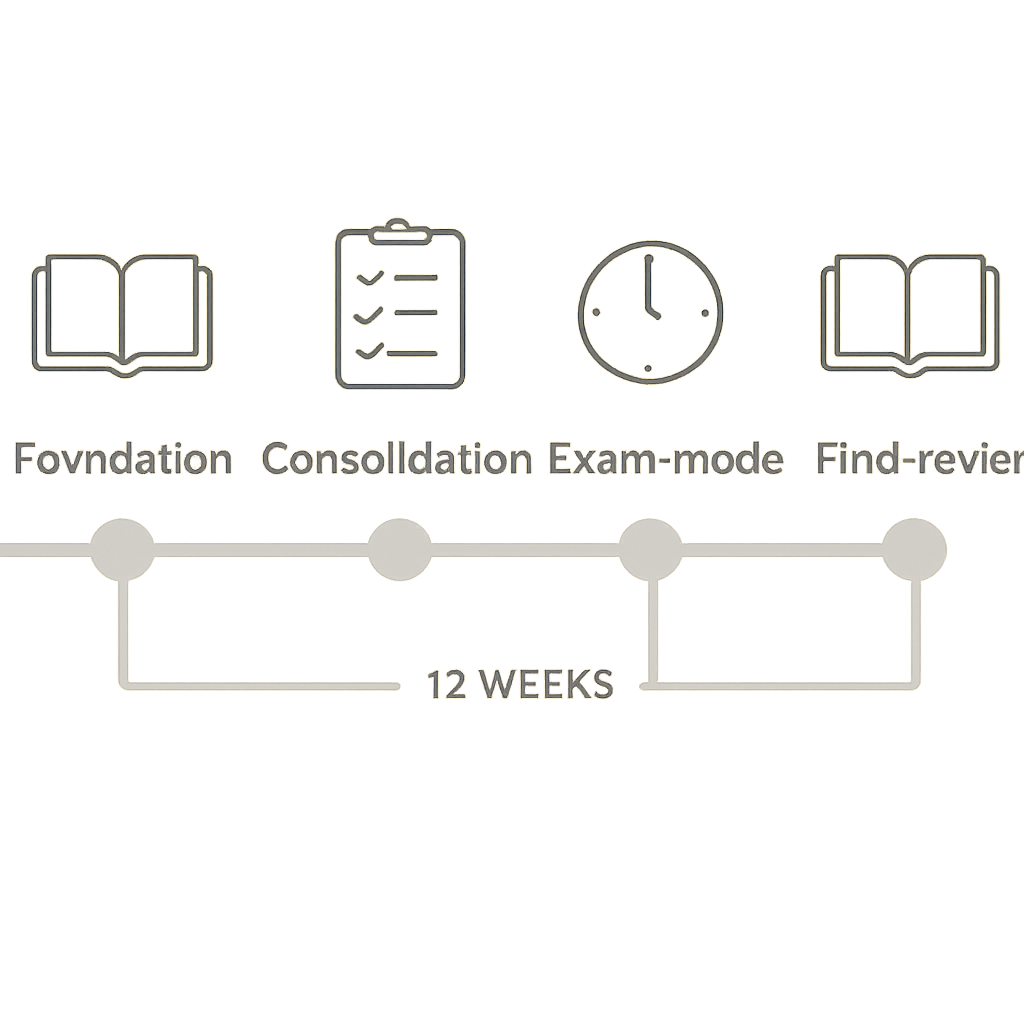
Next, use the 12-week plan when you need to rebuild weak areas without rushing, especially after a gap in studying or repeated low practice scores. A practical benchmark is that your first untimed blocks often start 15–30% lower than your goal, which is a sign to spend time on concepts before you push speed. By the end, you will have a weekly rhythm that moves from understanding to exam timing without passive rereading.

If you do one thing, do this: keep every study week anchored to questions, not just notes. Reading and videos are useful, but they fail when they replace recall and decision-making, which is what the exam tests.

Weeks 1–6: rebuild concepts with slower pacing and consistent question practice

Also, treat Weeks 1–6 as your foundation and consolidation phase. Aim for 5–6 study days per week with 60–90 minutes on workdays and a longer 3–4 hour block on one off-day, then repeat the same weekly pattern so it becomes automatic.

Use this simple loop to prevent passive learning:

  • Pick 2 systems per week (for example: cardiology plus respiratory)

  • Do 20–40 untimed questions per study day (split into 2 sets if you are tired after a shift)

  • Review every missed question and write a one-line reason (knowledge gap, misread stem, wrong prioritization)

  • Re-do a small set (10–15 questions) on the same topic 48–72 hours later

Common mistake and fix: doing long content sessions, then one big question day. Fix it by doing questions daily, even if it is only 15–20 items after call.

Weeks 7–12: shift to exam mode with timed sets, simulations, and test-day tactics

That said, Weeks 7–12 should look and feel like the exam. This works best when your accuracy is steady untimed and you can explain your wrong answers; it fails when you still cannot name the key rule or diagnosis, in which case you should keep 1–2 foundation blocks each week.

Move toward timed performance with a clear weekly progression:

  • Weeks 7–8: 2–3 timed sets per week (for example, 40 questions in a fixed time), plus targeted review

  • Weeks 9–10: 1 simulation-style session per week (longer, timed mixed topics), then a full review the next day

  • Weeks 11–12: 2 simulations total plus focused error correction and test-day routine practice (break timing, pacing, flagging rules)

If you are short on time: skip extra reading and do one timed mixed set, then review it thoroughly. A 60-minute timed block with a careful review often gives more score movement than 3 hours of highlighting notes.

Closing remarks

Also, keep coming back to a simple rule: "A plan only works when it’s measured and adjusted."

If your last practice score felt random, treat that as a signal to tighten one input, then re-check in 7 days. Most candidates improve predictability faster by changing one thing at a time instead of rewriting the whole schedule.

What will you change this week to make your next practice score more predictable?

  • Total study hours (for example, lock in 10 to 12 hours across 5 days)

  • Question volume (for example, 30 to 40 timed questions on 4 days)

  • Mistake review (for example, 45 minutes after each set to log the error type and the fix)

FAQ: Emirates Medical Residency Entrance Exam study planning

How many questions should I do per week on each timeline?

Use a weekly target tied to hours, not willpower. 4-week: 200–300 questions/week. 8-week: 150–250/week. 12-week: 100–200/week. If you can only study 6 hours/week, prioritize fewer questions with full review.

When should I start full-length mock exams, and how many are enough?

Start once you have built basic coverage and a review habit. 4-week: start in week 2, do 2–3 mocks. 8-week: start in week 4, do 3–5. 12-week: start in week 6, do 4–6, spaced 1–2 weeks apart.

What if I miss a week due to shifts or emergencies?

Do not try to “make up” everything. Restart with a 3-day reset: 1 day recap notes, 1 day mixed questions, 1 day review errors. Then continue the plan where you left off and trim low-yield topics first, not question review.

Get a structured exam-prep path with guided practice

Created with